Written by Ryan Ellis
Head of Storytelling, Royal Signals Museum
From its initial deployment of a team of 13 in support of a 1991 European Community Monitoring Mission, to the hundreds of signallers deployed on operations in support of the UN and NATO, deployments to the Balkans became a mainstay of the 1990s for the Corps. Deployments included Operations GRAPPLE, HAMDEN and PALATINE to Bosnia, as well as Operation AGRICOLA to Kosovo and Operation BESSEMER to Macedonia.
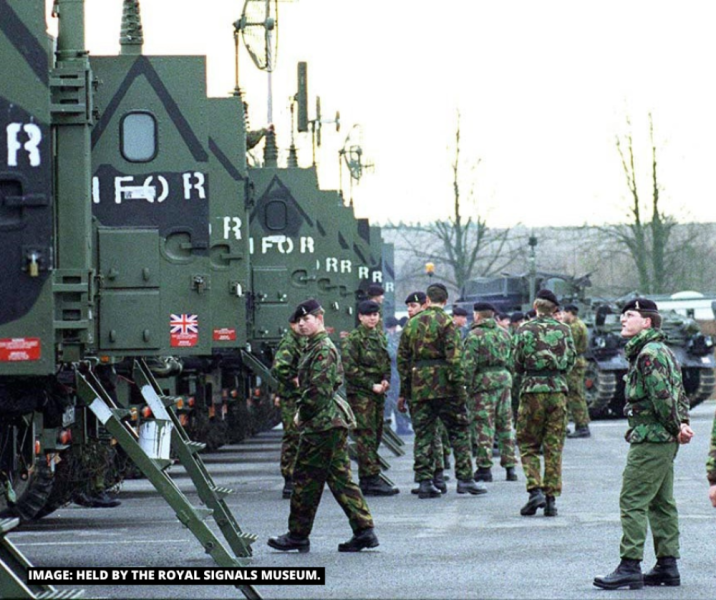
This collection of short stories, including extracts from oral history interviews conducted as part of the Museum’s new storytelling strategy, throws a spotlight on the peacekeeping role of the Corps. It also highlights how equipment such as Ptarmigan, Clansman and INMARSAT were used to deal with the challenging conditions and terrain.
.png)
Michael Stevenson: European Community Monitor Mission (ECMM)
When the UK took over the Presidency of the European Community, for 6 months, on 1st July 1992, it assumed responsibility for command and control of the European Community Monitor Mission (ECMM) and for its communications.
The ECMM was monitoring the cease fire line between Croatia and Serbia, trying to stabilise the situation in Bosnia and patrolling the borders of Serbia with Hungary, Bulgaria, Macedonia and Albania. They were 350 strong and unarmed.
In April 1992, disillusioned with the loneliness of a posting in London, Michael Stevenson volunteered to join the ECMM. In Split, having been met by two ECMM officers in an armoured Mercedes four-wheel drive car, he was raced past the perimeter in Zadar and towards the 65-metre-high Peruća dam.
The dam had been rigged with explosives by insurgent Serb forces during the 1991 Croatian war and was heavily damaged. The surrounding scene had also been scarred by the conflict: the carcasses of dead horses were scattered between blown-up vehicles. The voluntary posting posed an extreme test of his negotiation skills, with neither side keen to make progress.
Listen to this story by clicking here.
Mark Brookes: Deployment Quirks
In October 1992, UNPROFOR (United Nations Protection Force) extended into Bosnia. The UK deployed, on Operation GRAPPLE, an infantry battalion group, an engineer regiment, logistics and signals to Bosnia and a Brigade HQ to Split in Croatia. The initial role was to escort humanitarian aid convoys.
Crossing on the RFA Sir Bedivere on a fourteen-day voyage from Emden to Split, 2Lt Mark Brookes found he was listed on the ORBAT as a Driver Lineman, holding the rank of Signaller. The catch? He was yet to learn to drive. Whilst his role of Troop Commander had been omitted from the original ORBAT, assurances were given that it would be essential to mould the loose command structure found on arrival.
Charged with overseeing the first trip to drop off HF detachments in the region, Brookes found it difficult to maintain anything like an informed mobile network in the mountains on their VRC 321 Clansman radios. The solution was to strap back the antennas with green wool to use the near vertical incidence skywave (NVIS) theory he had learnt at Blandford.
Listen to this story by clicking here.
1.png)
Dave Mears: Working for the High Representative
When the Serbs subsequently mortared civilians in Sarajevo in August, the UN retaliated with a fierce artillery bombardment of positions from nearby Mount Igman. This was followed by a series of air strikes in September. This led the Serbs to agree to the terms of the Dayton Peace Agreement ending the Bosnian War and the direct UN involvement.
Responsibility for implementation passed to NATO’s Implementation Force (IFOR) which had a one year mandate lasting until December 1996. IFOR comprised some 55,000 troops from 35 nations formed into 3 Multi National Divisions with Lt Gen Michael Walker, Commander ARRC, as the Commander of the Land Component. It was a very different force to UNPROFOR and included main battle tanks.
When 19-year-old Dave Mears received orders to take over a Ptarmigan SCRA Terminal that had been dismounted into an office block in downtown Sarajevo, he could not believe his luck. The soldier found himself as Communication Lead Operator for the military cell within the Office of the High Representative for Bosnia and Herzegovina. Tasked with maintaining communications with IFOR, he also had access to INMARSAT and the TETRAPOL handheld local radio system.
Living in the office building on a camp cot that he had to pack away every morning to make space for the conference room, Mears had regular interactions with French and German officers, a British Major and a British two-star Air Vice Marshall. “Clearly, I got away with it”, he mused when recalling the responsibility he had as a young Signaller.
Listen to this story by clicking here.
Richard Spencer & Grant Johnston: Austere Conditions
Richard Spencer and Grant Johnston were Arctic Warfare Instructors from 249 Signal Squadron AMF(L). They were deployed to Bosnia in 1995 to establish the mountain top communications site on Mount Bjelasnica. This was the highest location of all British Troops in Bosnia and connected the HQs in Sarajevo and Kiseljak using Ptarmigan.
The UK team was a core of 6 from 249 Signal Squadron, plus 8 initially from 2nd Signal Regiment and then from 7th Signal Regiment. The site was shared with a dozen French and later Italian signallers, requiring maximum co-operation from the small British unit.
The position was snowbound from early November until late March with temperatures often below -200C. Snow had to be melted for water, and when the generators froze they had to light fires underneath them. The road up to their position was cut off and eventually even helicopters were unable to get through, so groups had to ski down and bring back supplies on foot. This was once the snow was deep enough to prevent buried mines from detonating.
Listen to this story by clicking here.