Written by Ryan Ellis
Head of Storytelling, Royal Signals Museum
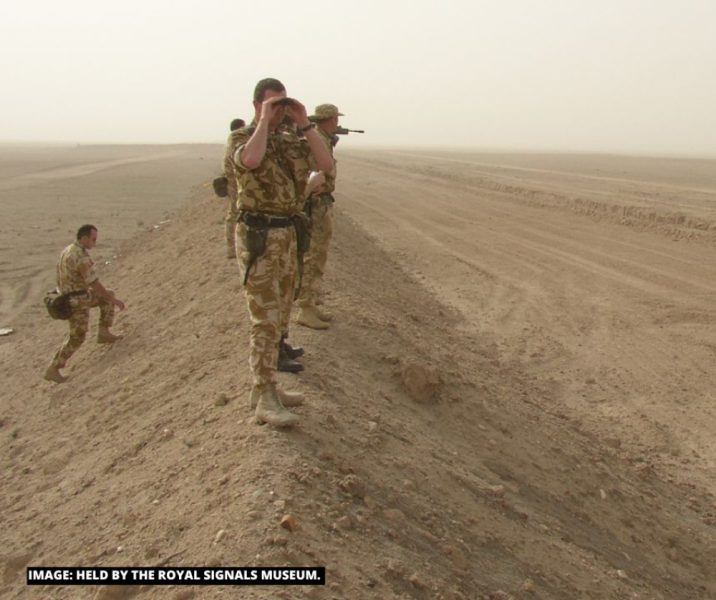
On 20th March 2003, coalition forces participated in an invasion of Iraq. During the warfighting phase, the Royal Signals contingent numbered almost 2,000 and lasted less than a month. With the Iraqi army putting up very little resistance, the British quickly secured the Iraqi port of Umm Qasr, set up a logistical base and established an HQ in Basra.
Britain’s part in the invasion, as well as the continuing support given to Iraq after the fall of Saddam Hussein, was codenamed Operation TELIC. The last remaining British Forces withdrew from Iraq on 22nd May 2011.
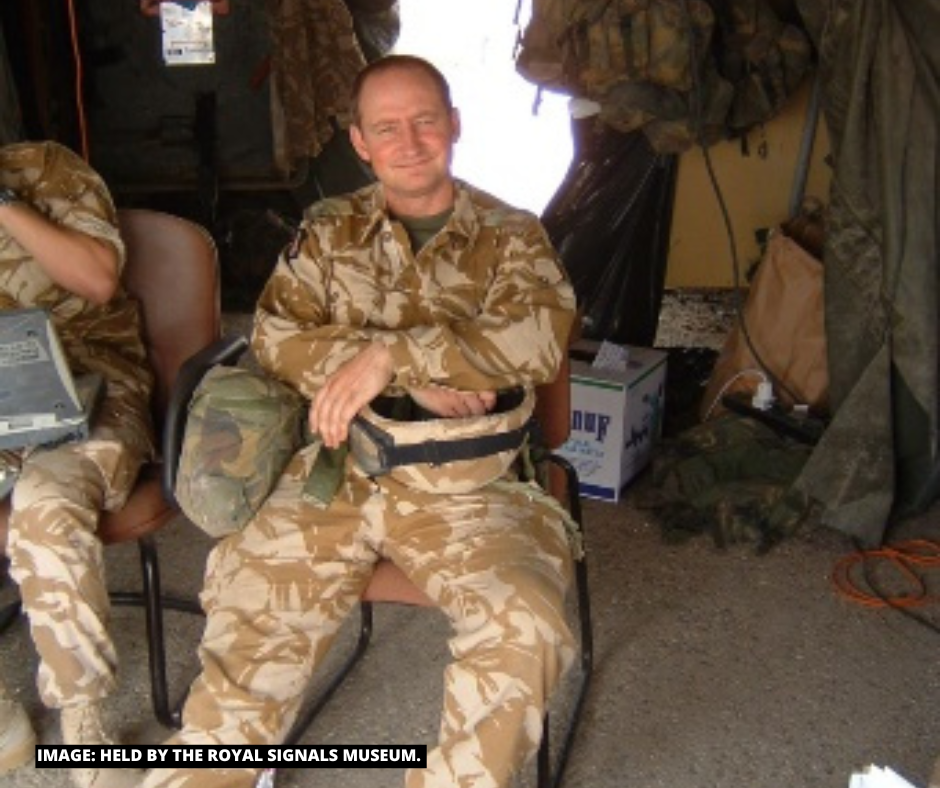
Chris Ford: Lessons Learned
As OC of 7th Armoured Brigade HQ & Signal Squadron in 2002, and with a likely deployment to the Gulf region on the horizon, Maj Chris Ford was acutely aware that it had been nearly a decade since the Brigade had undertaken an operational move. As such, Ford commenced a robust series of exercises in Germany and Poland focused on manoeuvre practice and setting up herringbone HQs. He also began an insightful and in-depth lessons learned review focused on Operation GRANBY, which highlighted possible future psychological hurdles for his men and women around the realities of living in the desert and deploying Ptarmigan as an advancing asset.
Despite his wise planning, the realities of Ford’s TELIC deployment required rapid and innovative thinking. After a failure of Ptarmigan during an exercise that took place 10-miles short of the Iraqi border, he sent his QM to purchase insecure satellite phones as an emergency backup. After a series of more successful exercises, in which Ford’s Squadron refined their plans around refuelling and the herringbone HQ technique, the warfighting stage commenced in earnest.
Listen to this story by clicking here.
Paul Steel: Scud Warnings
Swapping the amenities of Camp Commando, where vehicles had been resprayed and CBRN filters replaced, Sig Paul Steel adjusted quickly to the realities of his first operational tour. Out went purpose-built shower blocks, conventional toilets, and cookhouses; in came brief solar showers, desert roses (a pipe in the ground to use for comfort breaks), and ration packs.
When the advance into Iraq commenced, and although he was yet to obtain a driving licence, Steele found himself behind the wheel. Operating under the dim luminescent of convoy lights, Steele was in in full Romeo kit with his CBRN suit on and respirator at his side. When the convoy eventually came to a rest stop, under the 360-degree protection from the infantry battalions and their warrior vehicles, the familiar SCUD warning sounded again: “I remember going to sleep and waking up the next day with my respirator still on my face. It was that was that was the first night. You're at war.”
Listen to this story by clicking here.
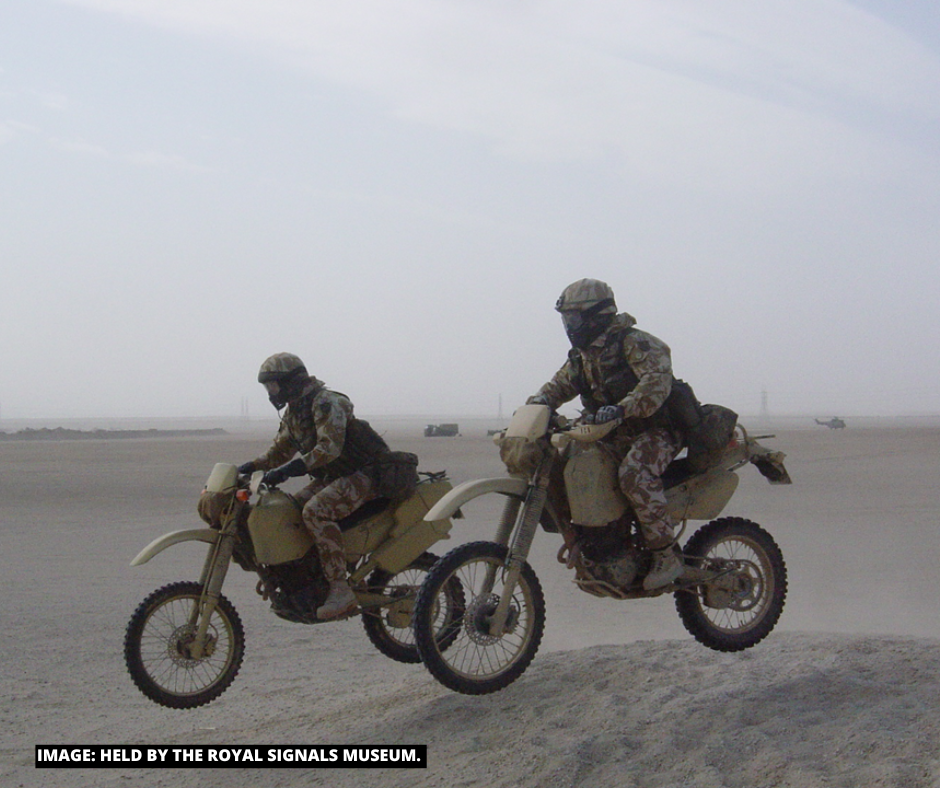
Jolyon ‘JJ’ Walker: Despatch Riding
Among those serving with 216 (Parachute) Signal Squadron was SSgt Jolyon ‘JJ’ Walker. Having gained his licence in 1986, Walker was an experienced motorcyclist who flexed his talents as the senior NCO responsible for training and development. Whilst Despatch Rider (DonR) was discontinued as a trade in October 1962, as TELIC began, DonRs were used to overcome the issue of signal backup, as well as to ferry staff officers between HQs. Walker recounts a four-day period where his team didn't stop: as he rode in, the bike was given to another rider.
Whilst much of the British Army were still operating the Harley-Davidson MT350, 216 Signal Squadron favoured the lighter Honda XR 250. The civilian cross-country motorcycle featured slight modifications including a sand-coloured respray to the body, duct tape to mask the red colour of the seats, the removal of the rear pegs and the addition of a bracket to carry a Garmin GPS 12XL device.
Listen to this story by clicking here.
Helen Bosley: Leading Young Soldiers
By Operation TELIC VIII in 2006, the British footprint in Baghdad had reduced. Now on her second tour of Iraq, having re-joined the British Army in 2002 to contribute to such campaigns, Major Helen Bosley (latterly Birchall) deployed in command of 206 Signal Squadron from 3rd (UK) Division Signal Regiment to provide communications for Lt Gen John Cooper CB DSO MBE (Deputy Commander of Multinational Force-Iraq (MNF-I)) and the operational-level HQ in Iraq.
Their role was to ensure that the operational CIS at the HQ, known as red (secure) and blue (coalition), were resilient enough to withstand the heat and dust. For the most part, her Squadron were desperate to receive real-world deployment experience: “They were young and inexperienced and a little bit gung-ho. You had to explain that they weren’t bullet proof and that they needed to think about what they were doing.”
Major Bosley’s warnings were apt. As well as the threat of IEDs, during their deployment the Squadron experienced 67 days of relentless overnight mortar attacks. “When this happened, you were straight out of the bed and on the floor, with your body armour and helmet on waiting for all clear. That became part of the routine,” she recalled.
Listen to this story by clicking here.