Written by Ryan Ellis
Head of Storytelling, Royal Signals Museum
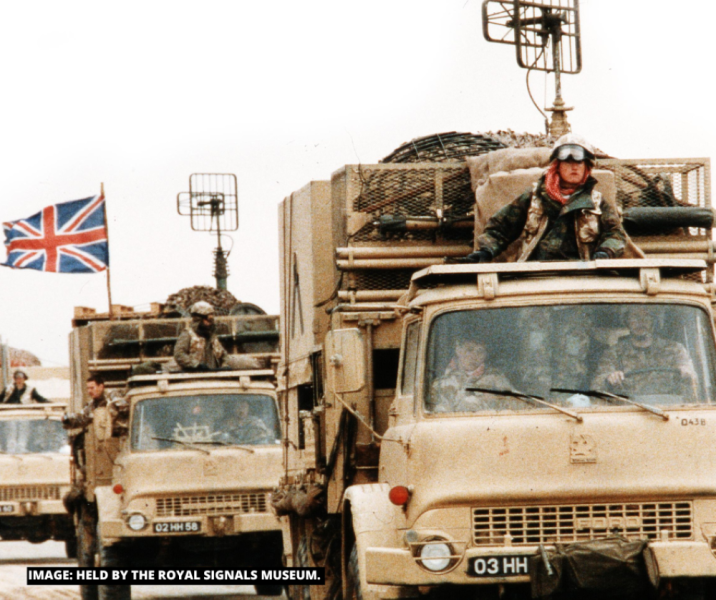
When it deployed on Operation GRANBY (1990/91), the Corps had not been involved in a major desert war for nearly 50 years. It needed to transform quickly from supporting defensive operations in farmland and forest (as part of the Cold War in Germany) to supporting offensive operations in the desert.
Tasked with providing long distance communications from the Persian Gulf region back to UK, as well as tactical communications within the theatre of operations, GRANBY also saw the use of Electronic Warfare equipment under armour for the first time. Importantly, it also marked the first operational deployment of Ptarmigan. This complete mobile area system could provide secure telephone, facsimile, data, and telegraph facilities to any user anywhere on the battlefield.
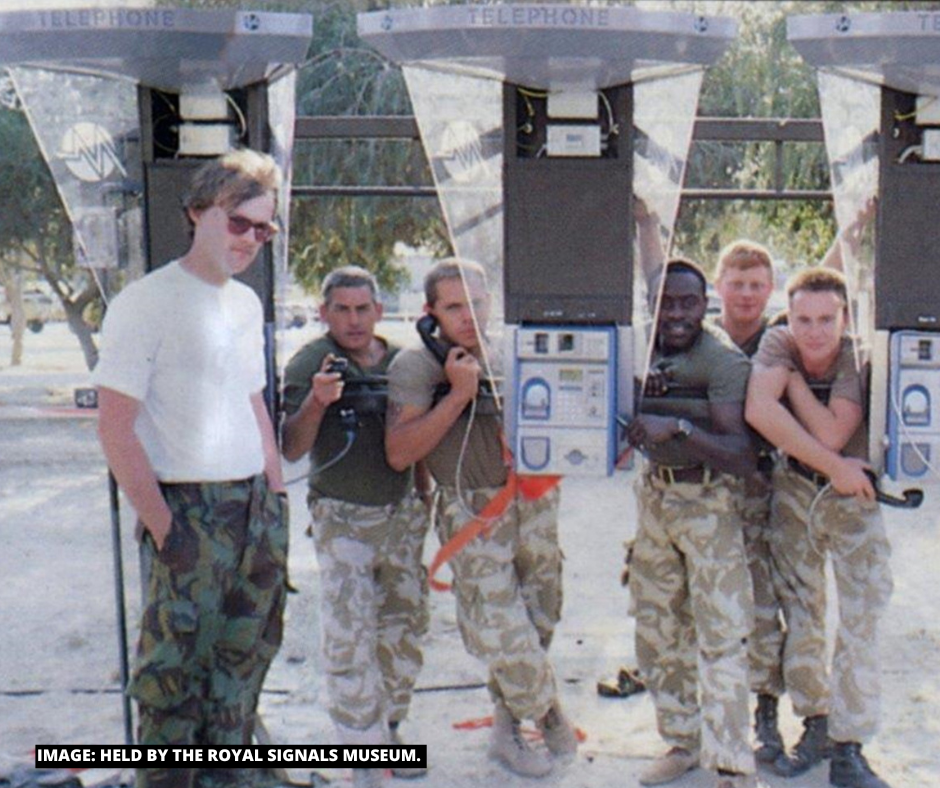
Bob Bruce: Installing Payphones
Waiting for the 1991 Gulf War was unsettling for many. To maintain morale, a R&R centre was established in Al Jubail. There was, however, only one payphone for the soldiers to call home. Cpl Bruce was among those tasked with installing a further 40. Working with an engineer from Cable and Wireless, his eight-man line team sited the phones, cemented them into position, laid and connected the cable and engineered them in. The entire process took only eight days.
Listen to this story by clicking here.
Jim Toms: Challenges with HF
Having spent six years in Germany training to confront a potential Cold War incursion from the Soviet bloc, Cpl Toms was “a little out of his element” when he arrived in the dry and arid desert terrain of Saudi Arabia and Kuwait. For the ground offensive, Toms utilised Clansman HF radios with a Ptarmigan SCRA Terminal as backup. The cat-and-mouse game played with Iraqi EW assets meant teamwork and technical innovations came to the fore.
In some respects, it was like re-learning his trade again: “It took us a while to work out that using a counterpoise was going to be the best way forward. Up until this point, the counterpoise was this horrible thing you chucked into the back of waggon but never used it. It became the most useful bit of antenna kit that we had.”

Walter Drain: Deployment Logistics
On arrival in theatre, and in his position as RSM of 7th Armoured Brigade Signal Squadron (207), WO1 Walter ‘Wally’ Drain’s immediate task was to create a sense of order and routine. In an ad hoc meeting with battlegroup RSMs, he made clear that weapons and respirators were to be always carried. Quickly, the maintenance of strict hygiene was drummed into officers and soldiers to avoid an epidemic of diarrhoea and vomiting.
When it came to the warfighting stage of the operation, and as A1 Echelon Command, Drain’s orders were to stay at least 10 kilometres (6.2 miles) behind the advance. To communicate, the RSM had a Clansman HF set. “To be frank, I could not communicate with them. I had no idea where they were, just the direction they were heading!,” he recalled.
He also had a Trimble navigation block (an early and rudimentary device supplying GPS data) and a paper map marked with mines. Following the surrender of Iraqi POWs, the Trimble would be used to report their location to the Royal Military Police Cell.
John Kirby OBE: Deploying Ptarmigan
Lt Col Kirby was both Commander Communications and CO of 1st Armoured Division HQ and Signal Regiment. For GRANBY, this included 1,350 vehicles, 520 trailers and 2,100 Royal Signals personnel in 11 squadrons, drawn from units all over the world. This was the first use of Ptarmigan to support an operation and it performed well, enabling 1st Armoured Division to plan and train in theatre and to deploy to its assault positions.
Many changes were made to the organisation of the Division which included increasing the number of FV432 armoured command vehicles at Main and Alternate HQs and putting Div Rear HQ into an armoured configuration. Ptarmigan deployed 16 trunk nodes in three squadrons, whilst three trunk nodes were placed under Brigade tactical control for the crossing of the Iraqi border. SCRA provided flexible comms from the start of the operation and new procedures were developed for using Ptarmigan in the advance after practicing for many years to fight a defensive battle in Europe.
Command and control at brigade and divisional level during the 100-hour land operation was exercised principally on combat-net radio. Once 1st Armoured Division went firm, a link into the Ptarmigan network was established quickly. This was essential as Ptarmigan was the bearer for the Desert Interim CIS System (DICS), the first deployment of battlefield CIS into an operational theatre. Significant technical challenges were overcome to allow areas of Ptarmigan to the linked together using satellite ‘bridges’ which allowed senior commanders to talk from the desert to Riyadh and the Ministry of Defence in London.
“Remarkably - due to a demanding training season in Germany in 1990, the self-discipline of the soldiers deployed and a good slice of luck - all 2100 members of Corps returned to their units at the end of the operation,” he recalled in a recent oral history interview.
Listen to this story by clicking here.