The Sierra Leone Civil War broke out in 1991 and over the following decade brought devastation to the country and its people. British involvement began with small advisory and humanitarian roles but grew as the crisis deepened.
In 2000, the Corps supported four major operations: Op PALLISER (evacuation), Op BASILICA (short-term training for the Sierra Leone Army), Op BARRAS (hostage rescue) and Op SILKMAN (longer-term training and advice). Together these operations demonstrated the Corps’ versatility in combat support, humanitarian assistance, and the rebuilding of national institutions.
Twenty-five years on, the Royal Signals Museum reflects on these deployments and commemorates the wide-ranging role played by the Corps in Sierra Leone.

Background: 1997 Coup
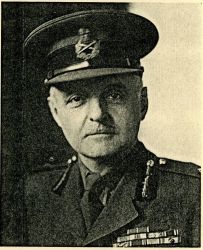
A British defence attaché is an advisor to ambassadors and British high commissioners on military matters, including threats, national security matters, disaster response and civil unrest. The attaché was expected to gather information and develop relationships with senior members of the host country’s armed forces. Fortunately, Lt Col Andrew Gale did so.
Gale was the defence attaché in Ghana in 1997 when, in Sierra Leone, the military overthrew the President and took power. Gale knew most of the army officers involved and so headed to Sierra Leone. There he managed to secure the safe departure of a jumbo jet with 400 British and other European nationals on board, even though the plane had been part of a Mexican standoff between rebels and armed Nigerian peacekeepers.
Later, the rebels shelled a hotel containing more Nigerian peacekeepers and some 800 civilians. Gale attached a large Union Flag to his car and drove around rebel positions persuading them to honour a ceasefire so the civilians could be evacuated. He was taken to the rebel HQ and may well have lost his life had not the overall rebel commander, who Gale knew well, arrived and released him.
Gale was awarded the QGM.
Operation PALLISER
The civil war continued and in May 2000 it was decided to deploy British troops under Brig David Richards, late Royal Artillery, to Sierra Leone as a precautionary measure in case a further evacuation was required.
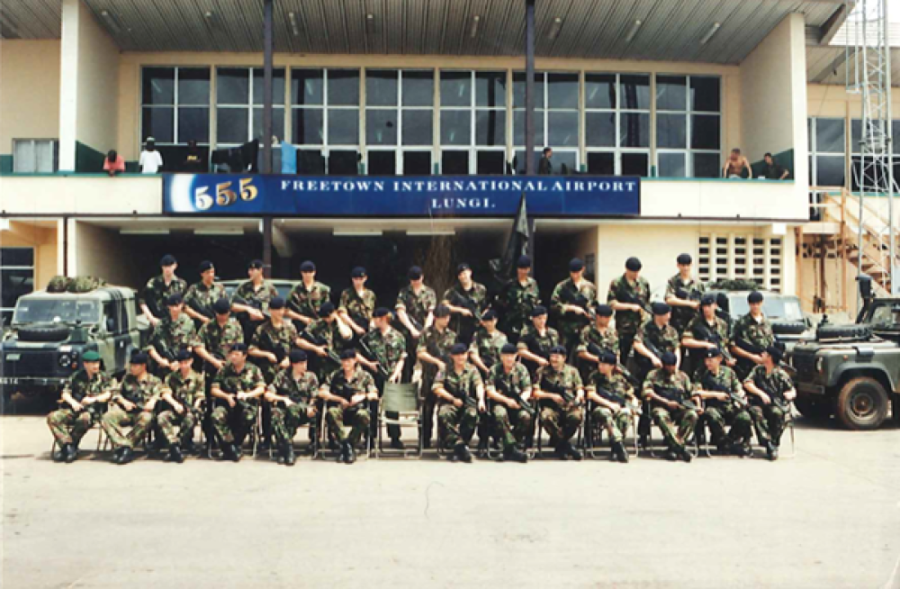
The Spearhead Land Element (SLE) of 256 Signal Squadron, 30th Signal Regiment, set up a Forward Mounting Base (FMB) in Dakar, Senegal, and the INMARSAT team of the Joint Task Force HQ (JTFHQ) established itself in the British High Commission in Freetown, Sierra Leone. Lungi Airport near Freetown was secured by 1st Battalion, The Parachute Regiment, with signallers from 216 (Parachute) Signal Squadron and SF soldiers and signallers. Then other members of 256 Signal Squadron, who had been on exercise with members of JTFHQ in Ghana, redeployed through the FMB to Lungi.
On 8 May, the British High Commissioner asked Richards to begin the evacuation and over the course of a week approximately 500 entitled persons were evacuated. WO2 Mark Tivey was the 256 Signal Squadron Sergeant Major in Ghana when the Squadron was ordered to deploy to Sierra Leone. He had several concerns about the operation:
· They did not have their weapons with them.
· When told that the weapons would be flown directly to Sierra Leone his concern became how they could be zeroed (calibrated to individuals to ensure accuracy).
· How he would fit the equipment that had arrived in Ghana by an Antonov heavy-lift aircraft into a smaller C-130 Hercules aircraft.
· Whether the OC, Maj Joe Cooper, would arrive into combat unarmed and half-naked.
The first 30/40 members of the Squadron flew out from Ghana with their combat trousers around their ankles. This was because their aircraft had lost its cabin pressure and had to fly at low level, resulting in incredibly hot temperatures. The crew just wore underpants. Cooper received a Queen’s Commendation for Valuable Service.

Operation BASILICA
After Brig Gordon Hughes handed over command of 2nd (National Communications) Signal Brigade, he was tasked with setting up an International Military Advisory and Training Team (IMATT) for Sierra Leone to help the government rebuild their armed forces. He took over as Commander of the British Forces in Sierra Leone from Brig Richards, positioned advisors across the Sierra Leone Army and arranged for Short-Term Training Teams (STTTs) to come out to start professionalising the Sierra Leone Army under Op BASILICA. 30th Signal Regiment provided communications support for Op BASILICA and then for the longer-term training and advisory programme that followed it under Op SILKMAN. 1st Mechanised Brigade HQ and Signal Squadron provided additional support at the start of SILKMAN. In late 2000, a ceasefire was agreed, large-scale disarmament began and further operations were really a show of force to help consolidate the peace process. The operations were seen as a major success and for several years British visitors found themselves warmly thanked as they entered and left the country.
Operation BARRAS
In August 2000, a 12-man patrol from the STTT was taken hostage by a militia group known as the West Side Boys. EW specialists from the Corps located the hostage takers and in September a rescue operation was mounted by elements of the SAS and the Parachute Regiment.
All British captives were rescued along with 22 civilians but one of the rescuers was killed. During the hostage period, a dedicated satellite link was set up between the UK and British HQ in Sierra Leone to keep families updated.

Concluding Remarks
By the time the Sierra Leone Civil War ended in 2002, an estimated 50,000 people had been killed. Hundreds of thousands more suffered atrocities including mutilation and forced recruitment, while around two million were displaced, creating a humanitarian crisis that scarred the nation for generations.
Against this backdrop, the contribution of British forces, and the Corps in particular, helped stabilise a fragile situation. Through rapid deployment, specialist communications, and support to both military and humanitarian efforts, the Regiment played a vital role in protecting civilians, strengthening local forces, and restoring confidence at a critical moment in Sierra Leone’s history.
30th Signal Regiment returned to Sierra Leone in 2014, assisting with an international response to the Ebola crisis. After 48 hours’ notice, Lt Joe Willden led a 10-person team from 258 Signal Squadron’s Early Entry Headquarters (EEHQ) to Freetown on 22 September 2014. Their task was to provide communications for the staff within the Joint Inter Agency Task Force (JIATF) back to the UK and to help ensure there were communications with the various locations where British forces were working. They provided Housekeeper and Defence Information Infrastructure (DII) laptop computers, Falcon IP phones and mobile phones for the Task Force and Swe-Dish and Mantis satellite terminals to provide connectivity back to the UK.
From civil war to public health crisis, these operations reflect the Corps’ enduring ability to adapt, respond, and deliver essential communications under the most challenging conditions.