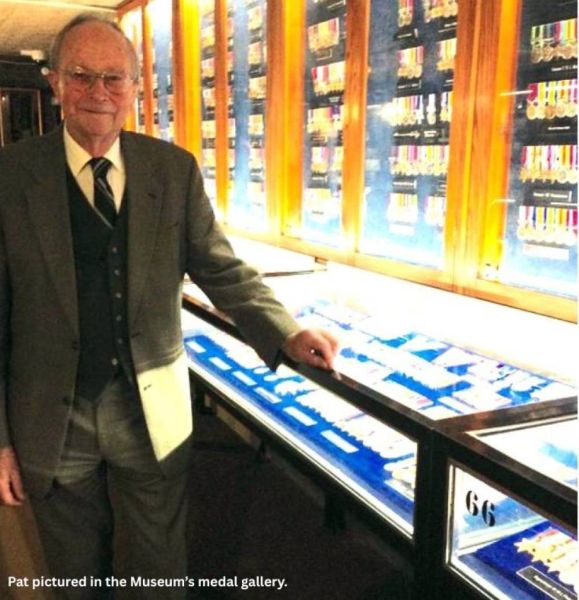
The Royal Signals Museum has recently lost one of its most long serving and well-loved volunteers. Lieutenant-Colonel (Retd) Pat Soward passed away last month at the age of 93.
The Museum’s Director Fritha Costain praised Pat as “an incredible man. He was integral to the development of the extension of the Royal Signals Museum. He project managed the build, working alongside Hayley Sharp interpretation consultants. He faced a number of hurdles that he, in his general manner, quickly overcame. He was also instrumental in raising funds for the extension, successfully persuading many people to donate for the museum cause. Following the conclusion of the project, Pat went on to become the museum’s Volunteer Manager, where he very ably coordinated and supported the volunteer team.”
The new wing was opened by the Princess Royal in 1995 and Pat was awarded the Master of Signals Award for his work.
On a more personal note, Fritha added:
“As a neighbour in Child Okeford, I am strongly aware of his importance to Child Okeford. For many years he was the editor of the local magazine ‘The Hill’ and led British Legion work in the village. I feel a great personal sadness at his departure. I spent many happy hours chatting with him, and Pat and his wife Maureen kindly gave us their piano, which was relocated to our house by pushing it along The Hollow in true village style, and has been an inspiration to my children ever since.”
Military Career
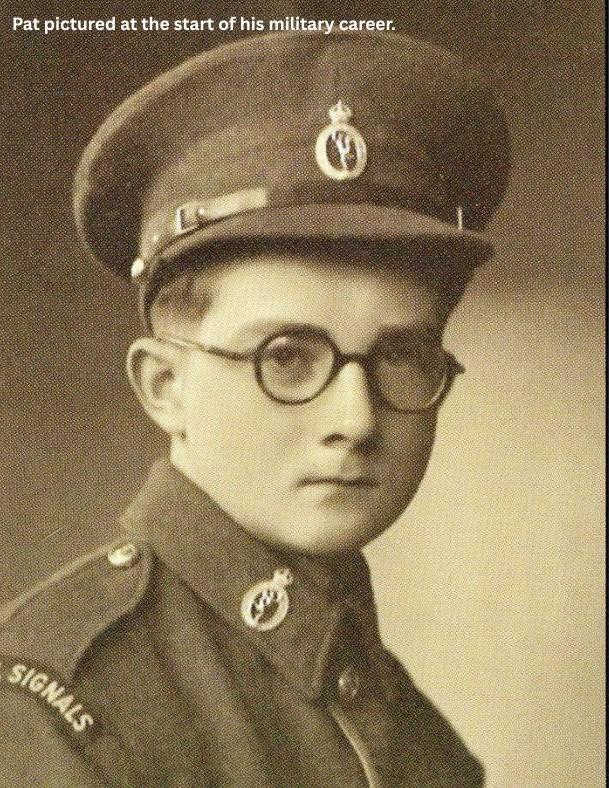
Pat Soward joined Catterick Boys’ Training Squad in the late 1940s. He carried on to Harrogate where he undertook a Radio Mechanic’s course at 1 Training Regiment. His first posting was to the Egypt Canal Zone.
“I started off as a Signalman. I was posted to the Army wireless chain receiver site, which was out in the desert. The circuits were going if necessary up to 24 hours a day. I lived on the site on call, got promoted to Corporal and then, after 13 months, I left for a Foreman’s course.”
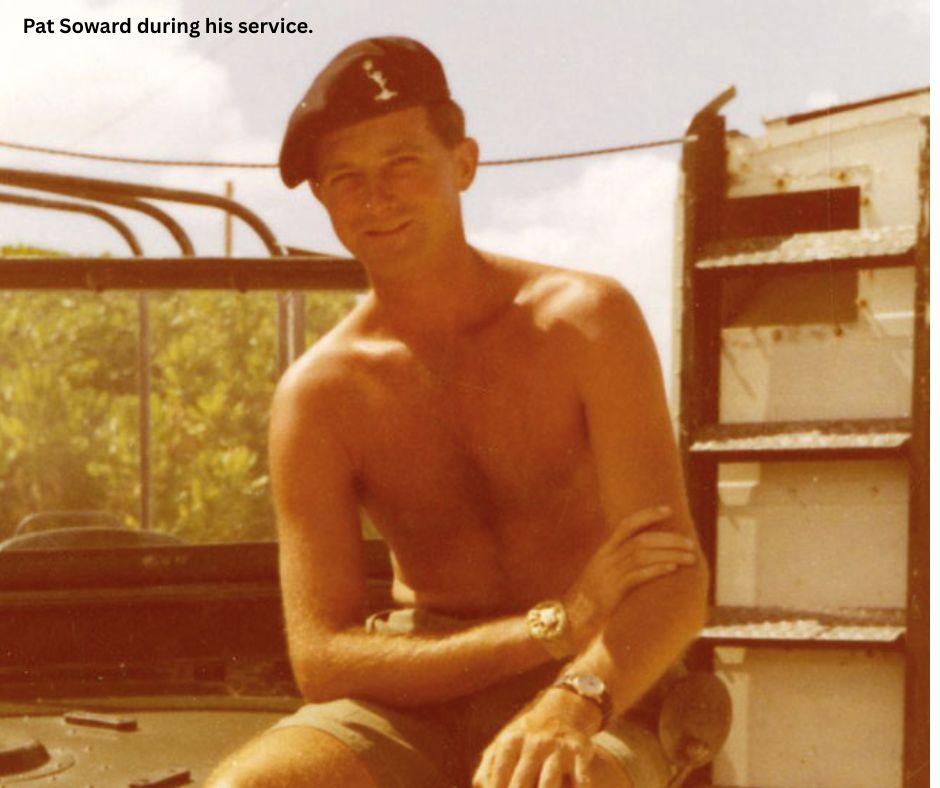
A period in West Africa was followed by a deployment to Christmas Island in the Pacific. From May 1958 until May 1959, Pat - then a WO2 - served with 2 (Special) Air Formation Signal Troop. The 65-strong Troop was upgrading the island’s telephone exchanges and lines. This was during Operation Grapple and the RAF were dropping megaton-yield hydrogen bombs from Valiant aircraft 23 miles south of the airfield. Pat experienced two of the megaton and two smaller nuclear explosions.
“The shockwave came through and bent the palm trees and it was quite something and then we turned round and we could look and see the mushroom cloud forming.”
Pat next served as an Instructor at 8 Signal Regiment and was commissioned in 1965. He was posted to Singapore on two occasions, acting for a time as Engineering Officer of No. 2 Signal Unit at RAF Changi. In the 1970s, he played a pivotal role in the development of Heli Tele, a real time air-to ground colour television helicopter surveillance system. It was introduced in Northern Ireland for recording and reporting on demonstrations. Pat remembered:
“My job was to write the urgent operational requirement for Heli Tele. If I just put it into context - if you want a new telephone or something like that, then normally that's a 10-year programme. The next incumbent will see the prototype models; the third incumbent will actually see the thing in service. But with an urgent operational requirement, that was all telescoped and you have the great satisfaction of seeing it from start to finish. This took a matter of just a few short months because everything came together. Amazing.”
Pat’s last role was with the Communications Project Agency replacing electromechanical exchanges and installing electric versions. This work took him to Ascension Island, the Falklands, Cyprus, Hong Kong and Belize. He retired as a Lieutenant-Colonel in 1990.
All this information was captured in a 2022 interview conducted by the Museum’s former Head of Storytelling, Ryan Ellis. Ryan fondly remembers Pat as an avid researcher and historian of the Corps.
“Beyond his military career, Pat painstakingly compiled the Museum’s tour notes, pamphlets and historical records that have guided generations of staff and volunteers. His scholarship ensured that the heritage of the Royal Signals was preserved with accuracy and depth and his work continues to underpin exhibitions, publications and outreach today. Those who visited the museum will remember Pat and his devoted wife Maureen, volunteering together on weekends at the Museum. Sadly, Maureen passed away earlier this year. Their presence embodied the spirit of service and camaraderie that defines the Corps. Pat’s warmth, generosity and encyclopaedic knowledge enriched the Museum and inspired all who worked alongside him.”
Recently retired Director Nick Kendall-Carpenter echoes this sentiment of selflessness and service.
“I only knew Pat for the last 15 years of his long life but I will be forever grateful for the support and encouragement that he gave me during these years in my role as Royal Signals Museum Director. In his recent eulogy for his late wife, Pat described both himself and Maureen as extraverts. They were extraverts but not in the way that the term is used in common parlance. Pat did not seek out the limelight or wish to have his contributions noted and applauded. He took his energy from the people around him and he returned that energy with dividends. His energy was breathtaking. He epitomised the unselfish team player doing all he could to support and help team members so that the team might perform as well as it possibly could. As a result everyone wanted him in their team. His family was his most important team and he was very proud of those lucky enough to be part of it but he also was pillar for the Royal Signals Museum, the 254 Old Boys Association and for Air Formation Signals veterans as well, I am sure, for numerous other Royal Signals and local teams. He was always being asked for help or for information and he always did what he could to provide it, usually along with a smile and a sparkle in his eye. I never once heard him complain or criticise. If the world had more people like Pat and Maureen in it then it would be a much better place.”
As well as his work with the Museum, Pat also joined the Air Formation Signals Association and acted as Publicity Member, recruiting new members and producing and distributing regular newsletters. He also joined 19th Signal Regiment Association as a founder member and became the newsletter editor and Chairman. In 2023, Pat received the prestigious honour of a 75 Year Award for time served to the Corps and the Association combined.
Perhaps aptly, due to his tireless work with the RSA, the title of this piece comes from the Royal Signals Association Operations Manager, Tracey Muers. Tracey knew Pat personally and undoubtedly reflects the views of many people who met him.
“The man was a legend and a gentleman and will be sorely missed.”