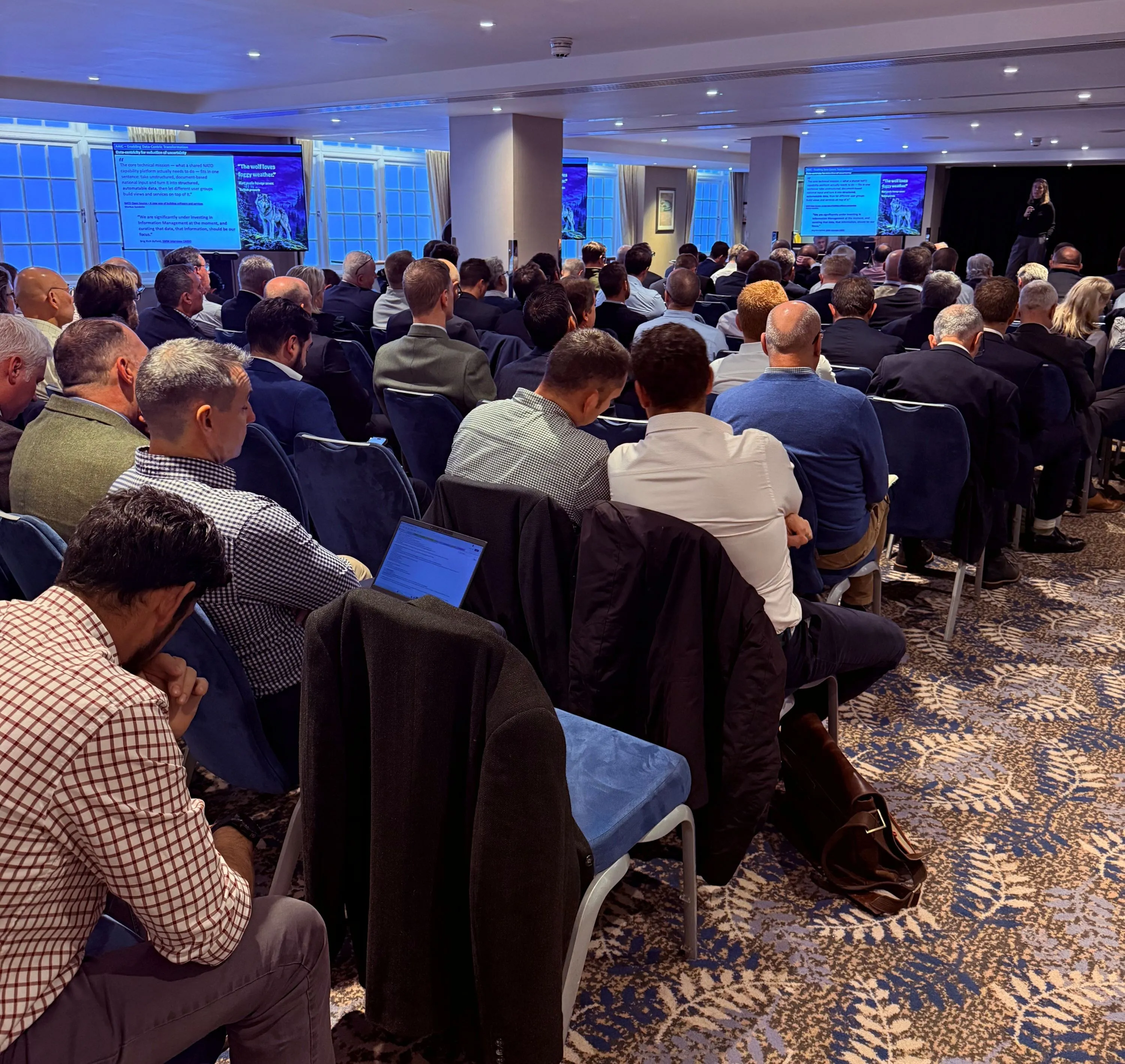
The Royal Signals Institution’s Autumn Seminar, Enabling a Data-Centric Army, brought together senior Army leaders, practitioners, industry representatives and professional institutions to explore how data can deliver operational advantage.
Across presentations and panel discussions, speakers examined the technologies, structures and skills needed to move towards data-centric operations. A consistent message emerged: the challenge is no longer simply connecting systems or acquiring new technology. It is ensuring that information can be trusted, shared and exploited quickly enough to support decisions in complex and contested environments.
The seminar explored this challenge from severalperspectives, from Defence’s approach to artificial intelligence and thedevelopment of Land Domain C4, to practical lessons from experimentation andthe role of professional development and industry partnership.
Land Domain C4: The Next Chapter
Brigadier Lizzie Mortimer outlined the shift in Land DomainC4 (LDC4) from a traditional equipment replacement programme to a broader effort to transform digital and military capability.
The programme’s focus is on creating a resilient, interoperable and architecture-led digital ecosystem that delivers operational advantage today while remaining adaptable to emerging technologies. Mortimer described three guiding principles: delivering warfighting effect, designing for interoperability from the outset, and accelerating capability through iterative, evidence-based delivery.
The approval of the LDC4 Strategic Outline Case and closer alignment with Defence’s wider digital backbone have helped establish momentum. Rather than defining a single end-state solution, the programme is adopting an epoch-based approach. Each phase is intended to deliver tangible capability, generate evidence and inform future investment decisions. This should reduce the risk of locking Defence into technology that may quickly become obsolete.
Mortimer also discussed accelerated work to support the mobile anti-armour force, using operational activity as a proving ground for integration, data sharing and interoperability. The approach is intended to deliver capability while generating lessons for the wider programme.
Industry engagement is also changing. Defence needs to involve industry earlier to understand what is available, test integration approaches and inform decisions before major investment. At the same time, Defence must retain ownership of its requirements and architecture.
Interoperability is increasingly treated as a design principle, not something added after delivery. Mortimer also highlighted the potential of commercial 3GPP technologies, including private LTE and 5G, as additional elements in a wider communications ecosystem - not replacements for military systems.
The aim is a connected digital environment that links tactical networks, decision-support tools and the wider Defence digital backbone to help commanders sense, decide and act faster.
Defence and Army Artificial Intelligence: Building the Foundations for Adoption
Brigadier Caroline Woodbridge-Lewin, Head of the Defence AI Centre, and Lieutenant Colonel Kitty Small, Head of the Army AI Centre, explored what it will take to make the Army AI-enabled.
Woodbridge-Lewin argued that success depends on more than acquiring a powerful model. Defence must build the wider environment in which AI can be developed, assured, deployed and sustained. That includes reliable data, infrastructure, governance, security and the skills to use these capabilities effectively. AI transformation, she stressed, is fundamentally a human endeavour.
The Defence AI Centre is moving towards a federated approach: connecting and coordinating work across Defence rather than attempting to deliver everything centrally. Its priorities include integration, functional leadership and adoption. The aim is to reduce duplication, encourage reuse, establish clear standards and help organisations make effective use of available tools.
A key challenge is the “exploitation gap” between demonstrating an AI capability and making it work reliably in an operational setting. Data may be held across separate systems, while security, infrastructure and assurance arrangements can make integration difficult. Woodbridge-Lewin described AI as a living capability, requiring continuous assurance as data, models, threats and operational needs change.
Small explained how the Army AI Centre is working to reduce bespoke delivery routes and build a more coherent Land Domain Digital Ecosystem. This includes developing a software factory and data fabric to support integrated, secure and adaptable digital products.
Both speakers emphasised the importance of starting with operational problems, understanding the threat and ensuring that AI enhances human decision-making. Access to AI is only the beginning; meaningful adoption depends on the foundations beneath it.
Data as a Core Operational Enabler
Major General Mark Purves, Director Army Digital Security and Intelligence, described data as a fundamental source of operational advantage in an increasingly uncertain security environment.
He argued that Defence must be prepared to respond at pace, rather than relying on distant milestones. Data has the potential to transform how the Army operates, including how headquarters manage complexity and how commanders make decisions. But that requires a change in focus: from individual platforms and applications towards the data itself.
Purves highlighted progress already made, including work on data standards and the use of Asgard to reduce some planning cycles from around 72 hours to approximately two. The objective is to help the Army think and act faster than its adversaries.
Standards are essential to this ambition. They allow information to move between systems and partners, supporting interoperability and reducing the time needed to connect capabilities. Purves stressed that Defence must also understand how to integrate systems and data, rather than become dependent on individual suppliers or isolated solutions.
He encouraged industry to prioritise interoperability overdependency and to help make data available for wider use. The future fight, he said, will be a national effort, requiring Defence and industry to work together.
Data is not only relevant to frontline operations. Logistics, engineering, communications and other supporting functions depend on information being available and usable. The foundations that enable the force are therefore as important as the platforms and equipment they support.
Purves concluded that the Army is moving in the right direction, but the challenge is to harness that progress and deliver at the pace required. Data must be treated as combat power, supported by clear standards, secure access and the ability to integrate capabilities quickly.
Panel Discussion: Expertise, Professionalisation and Partnership
The final panel, chaired by Colonel Chris Dixon, considered what must change across people, professional standards and industry partnerships to make data-centric operations a reality by 2031.
A recurring theme was the need to improve data literacy across the force. Panel members argued that personnel at every level should understand how to interpret, question and use data. Specialist expertise will remain essential, but a broader understanding of data must become part of everyday military practice.
The panel also discussed the need to make training more agile. Traditional processes can be slow to adapt to changing technology and operational requirements. Speakers called for clearer links between operational needs, training design and delivery, with the ability to update training as new capabilities and threats emerge - while maintaining standards.
Professional institutions and industry can help by aligning training and qualifications with recognised professional standards. This could make skills more visible, support career development and help Defence and industry understand the capabilities of the workforce. The panel also highlighted the need to recognise skills already gained through military training and apprenticeships.
Industry was seen as an important partner in developing scalable training and sharing lessons from other sectors and allied forces. However, collaboration needs to be supported by mutual trust and a willingness to break down organisational silos.
The discussion extended beyond training to recruitment and retention. Speakers noted the importance of helping young people understand the breadth of Royal Signals work, and of giving personnel meaningful opportunities to develop and apply their skills.
The panel’s conclusion was that technical change must be matched by cultural change. Data-centricity needs to become a shared way of working across Defence, supported by accessible standards, continuous learning and closer partnership with industry.
Enabling a Data-Driven Formation: Lessons from Project Convergence Capstone 6
Major Warren Disney, Lieutenant Colonel Ed Vickers, Sergeant Cameron Melville and Corporal Dylan Smith examined the practical lessons from Project Convergence Capstone 6 (PCC6) and their relevance to the Forward Land Forces commitment in Estonia.
PCC6 brought together more than 10,000 participants from the Five Eyes community to experiment with networks, autonomous systems and new power solutions. The UK demonstrated its largest overseas network to date and connected multiple systems and partners. The work showed that data could be shared across formations and coalition boundaries, supporting a more integrated operational picture.
The speakers’ central message was that a data-driven formation is not created by collecting more information. It depends on trusted, accessible information that enables better decisions. PCC6 tested the movement of data through operational “mission threads”, including tactical awareness, device management, data standards and the distribution of full-motion video.
The exercise also exposed barriers. In many cases, the limiting factors were not the technology itself, but funding, approvals, accreditation, permissions and governance. The speakers argued that networks must be treated as part of the weapon system, and that commanders need appropriate authority to manage digital risk.
The experience is particularly relevant to Estonia, where dispersed forces must operate across a large battlespace alongside allies. The team highlighted the need to connect sensors, robotics and headquarters while maintaining survivability and communications.
Looking ahead, the challenge is to turn experimentation into enduring capability. That will require better metadata and data fusion, clearer visualisation, AI-enabled decision support and the ability to process information locally when communications are degraded or unavailable.
Professional Placements: Bringing Industry Knowledge Back into Defence
Major Abigail Robinson introduced the Royal Signals Professional Placement Initiative, drawing on her own experience of working with technology company Datacom. During her placement, she led a major cloud infrastructure transformation project, assessing technical and commercial options and presenting an evidence-based recommendation to the company’s board. The experience gave her insight into industry’s approach to technology, risk, investment and delivery, as well as the opportunity to lead work with significant strategic consequences.
Robinson explained that the value of placements goes beyond exposure to new technologies. They can help personnel understand how industry makes decisions, tests solutions and aligns technical choices with business outcomes. These perspectives can then inform capability development within Defence.
The initiative aims to make placements more accessible by creating a structured, repeatable process with selected RSI Corporate Members. The first round is planned for 2027, with three short placements for Royal Signals senior NCOs, warrant officers and officers. Opportunities will be competitively selected and aligned with Defence priorities, including cloud, cyber, data, AI, connectivity and systems integration.
Major Rob Preston outlined the wider policy and governance framework supporting placements, while emphasising the importance of clear objectives and appropriate support. Participants will be expected to share their learning through reports, presentations and articles, turning individual experience into institutional knowledge.
The initiative is intended to benefit both sides: Defence gains industry insight, while host organisations gain the experience and perspective of military personnel. Its success will be measured by the value of the learning returned to Defence, rather than simply the number of placements completed.
Professional Placements in Practice: A Mutual Benefit
A discussion involving Robinson, Preston and John Cole, Director of BT Defence, explored the practical benefits and requirements of industry placements.
Cole drew on his own placement with BT in 2017, undertaken while preparing for a future Army role in digital transformation. He explained that the purpose was not to find a route into civilian employment, but to understand how a large, complex organisation operated and how its Chief Information Officer worked with the executive team. He returned to Defence with fresh ideas and a broader perspective.
The panel emphasised that placements should provide value to the host organisation as well as the participant and Defence. Military personnel can bring leadership, technical skills, problem-solving experience and an external perspective. In return, they gain experience of different working practices and technology environments.
For placements to succeed, host organisations need to provide a clear sponsor, appropriate tools and access, focused objectives and support from a coach or mentor. Participants should be given meaningful work rather than treated as observers. Where possible, objectives should also be aligned with the participant’s next military appointment.
The discussion highlighted the importance of making the scheme accessible to organisations of different sizes, including SMEs, rather than limiting opportunities to large defence companies. The initiative is intended to begin with a small number of placements in 2027, with scope to grow if the first year demonstrates clear benefits.
The panel also considered how skills gained through placements can be recognised and captured across Defence. Its wider message was that structured, well-supported placements can create a genuine exchange of expertise and help strengthen the relationship between Defence and industry.
Conclusion
The seminar demonstrated that enabling a data-centric Army is a broad transformation, not simply a technology programme. The presentations showed how data can support faster decisions and greater operational advantage, while also highlighting the organisational, technical and human challenges that must be addressed.
Across the day, speakers returned to the importance of trusted and accessible data, interoperability by design, adaptable delivery and meaningful collaboration with industry. They also emphasised that people remain central: personnel need the skills, confidence and professional support to exploit new capabilities effectively.
The challenge now is to turn experimentation and ambition into enduring capability. By connecting technology, governance, training and partnerships, Defence can build a more resilient and adaptable digital environment - one that enables the Army to make better-informed decisions and respond at the speed required by future operations.